Sixty years after he began to paint 8.7cm stripes, at this point we have a number of Daniel Burens to reckon with. We have the counter-cultural Buren of the 1960s, an artist who sought to critique the museum, while transcending formalism, in a painting practice linked to Institutional Critique, as well as the project of finding a direction for abstract art after Greenberg. Ironically, we have—since the mid-1970s—the institutionalised Buren, the ‘official artist of France’ according to one New York Times critic,a fixture on the international art world’s circuit of blue-chip museum shows and biennales. Finally, since the 1980s, we have the public art Buren. Having received numerous high-profile state and corporate commissions over the last four decades, today buildings, civic squares, transportation hubs, and riverside developments all around the world display Buren’s recognisable striped motif, his so-called ‘visual tool’.
What is not widely known or discussed is that an important early chapter in Buren’s turn to public art took place in Glasgow in the late-1980s. Around the time Buren was completing his most famous public art commission, Les Deux Plateaux (1986), a site specific installation in the courtyard of the Palais Royal in Paris, he accepted an invite from curator and public art commissioner, Isabel Vasseur, to participate in Art in the Garden––a major exhibition that would take place within the grounds of the forthcoming 1988 Glasgow Garden Festival. Driven by the policies of a Labour controlled council led by the charismatic, if not always popular, Gorbals-born politician, Pat Lally, Glasgow sought a solution to the challenges of deindustrialisation by embracing Thatcherite policies designed to promote ‘urban regeneration’.[1] One of these policies was to support cities to host ‘National Garden Festivals.’ The first of these festivals took place in Liverpool (1984), followed by Stoke (1986), then Glasgow (1988).[2] Guidelines were dictated to hosts by the Department of the Environment in Westminster, and broadly followed the German ‘Bundesgartenshau’ model, a series of biennial festivals that began in 1951 with the aim to draw investment back into inner city areas decimated during the war.[3] Department of the Environment guidelines required that festival locations be derelict former industrial sites close to a city centre that could later be reclaimed to facilitate inner city regeneration led by new, enterprise-focused public-private partnerships.[4] The Glasgow Garden Festival was to be situated in a new urban park constructed from scratch on the exposed southern bank of the River Clyde, a 64-hectare industrial quayside formerly known as Prince’s Dock. Funding this enterprise was the UK Government, The Scottish Office, the Scottish Development Agency (SDA), European Economic Community (EEC) grants, Strathclyde Regional Council and Glasgow District Council, as well as a number of corporations, including Clydesdale Bank, Tennent Caledonian Breweries, Coca-Cola, and Scottish Power.
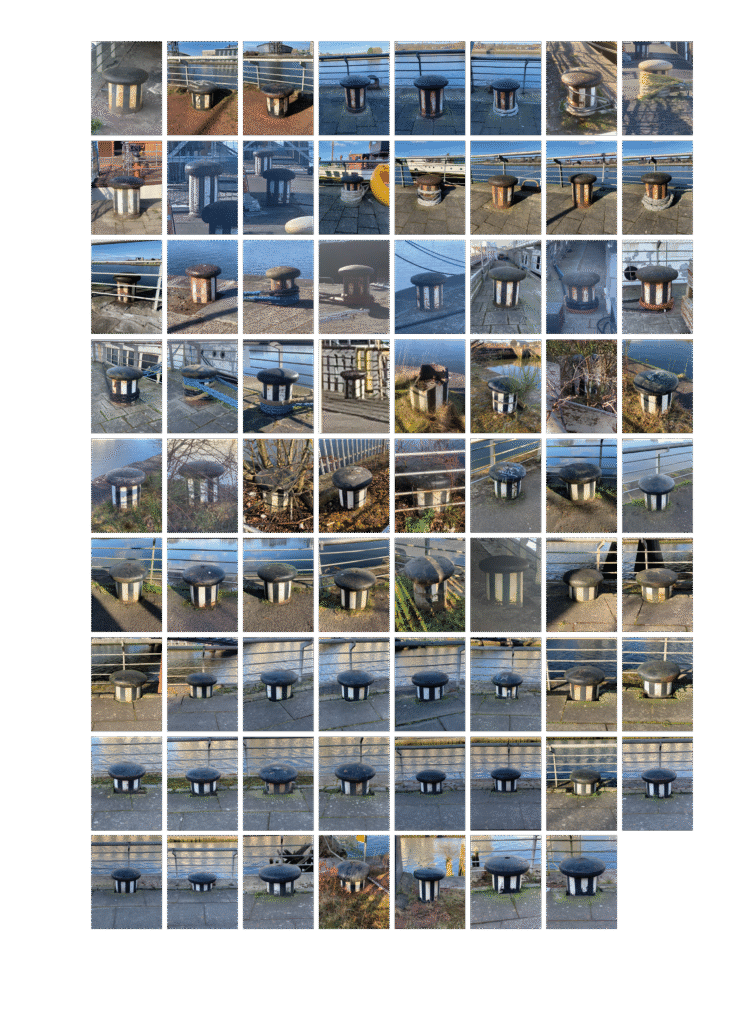
Collaborating directly with the senior architect of the festival site, George Mulvagh of Gillespie and Partners of Glasgow, Vasseur had less than two-years to plan and deliver her arts programme. Working at pace, she fundraised around £800,000 for the programme, money distributed between thirty-two artists in a commissioning process overseen by a steering group consisting of representatives from the Scottish Sculpture Trust, Scottish Sculpture workshop, the Scottish Arts Council, and Art in Partnership (Scotland). Announcing her final programme, Vassuer observed that “since Liverpool in 1984 and Stoke in 1986, the visual arts have played an important part in garden festivals”, continuing to say that “the aim of the Glasgow Garden Festival [was to] similarly bring an exciting collection of works by contemporary artists to integrate with the 100 acres of gardens and landscaping of the site.”[5] Set in and on the river, as well as upon the green spaces reclaimed by Gillespie and Partners were artworks by artists such as Eduardo Paolozzi, Marc Camille Chaimowicz, Richard Deacon, Ian Hamilton Finlay, Henry Moore, William Turnbull, and George Wylie, amongst others––including, of course, Buren. Buren’s contribution saw him paint 170 marine mooring bollards with black and white stripes. Some of these bollards were existing fixtures of the former dock site, while others were installed in the festival’s green spaces.
Contributions from selected artists were positioned amongst corporate sponsored pavilions showcasing industry and enterprise. In this way, contemporary art found itself integrated into a display that projected a new, to some extent hopeful, image of the city in which a group of state and corporate neoliberal elites would prevail as the inevitable engineers of a social renaissance in Glasgow. To consider the Garden Festival is, therefore, to witness a new kind of urban representation take shape, a representation designed to render up and lay out new meanings for the city as part of its post-industrial transformation.
Forty years since the Garden festival closed and the quayside bears very few of its original marks. One exception here is Buren’s bollards: a total of seventy two of the original bollards still remaining in situ.[6] And while their alternating black and white stripes are now scuffed, chipped or partially rusted away, it seems to me that Untitled: 170 Bollard continues to maintain its status as an artwork. I would like to propose that this enduring or resilient quality, read in combination with an understanding of the conceptual logic of Buren’s striped motif derived from his late-1960s writing, offers a chance to take a critical look at the legacy of the Garden Festival, while also inquiring after the proper purpose of contemporary art in an era of ‘culture-led regeneration’. In order to move towards an explanation of these propositions, readings that will ultimately implicate Untitled: 170 Bollards in a set of contradictory operations vis-a-vis the Garden Festival and the ideology of regeneration at work within it, it makes sense to begin our analysis with an outline of the conceptual logic of Buren’s stripes.
It is widely accepted that Buren’s stripes engender what Kenneth R. Allan has described as the ‘calculated deflection’ of the viewer’s attention away from the work itself and towards its location. While looking at Buren’s stripes we are supposed to be let down by what Allan describes as their ‘deliberate lack of optical vibrancy’.[7] But, just at this moment of deflation, the environment or landscape in which the stripes are located is supposed to come into view. While appearing to be an expression of the kind of austere geometric abstraction that marked late-Modernist painting and sculpture of the late-1950s and 1960s, in this way Buren’s painting actually succeeds in negating the traditional specificity and self-referential autonomy of the modernist work by situating the viewer phenomenologically and equipping them with clarified attention. As Buren wrote of his abstract painting in 1969: “one of the characteristics of the proposition is to reveal the ‘container’ in which it is sheltered”. This, for Buren, involves a “revelation of the location itself as a new space to be deciphered.” [8] It is in this sense that Buren describes his stripes as a ‘visual tool’. Far from being merely formal gestures, Buren’s stripes are designed to help us see the sites in which they are located in new, hopefully revealing ways.
One way of framing Buren’s contribution to the Garden Festival is that this concept of vantage-making abstraction reached an apogee with Untitled: 170 Bollards. 80cm wide and about a metre high, Buren’s bollards encouraged people to sit or even stand on them in order to get a better view of the festival site and surrounding quayside. This vantage-making power is something Kirsty Milne observed when, in her review of the Garden Festival for New Society, she described how Buren’s “gloss-painted gnome-like stools” offered festival visitors the opportunity to ‘gaze’ at the redeveloped festival site––an observation confirmed by numerous archive photographs that capture visitors either sitting or standing on the bollards as they survey the transformed quayside.[9]
Given the resilience of Untitled: 170 Bollards, it seems reasonable to say that Buren’s artwork retains this vantage giving power today. This in mind, I recently returned to the location the festival once occupied, climbed on a number of Buren’s painted bollards, and took in the scene. What I saw was a site that has undergone large-scale urban redevelopment and is now partitioned into neat quarters, each serving a particular function. Immediately west of Kingston Bridge, for example, is the service zone of Glasgow Quay, with its multiplex-cinema, bowling alley, bingo hall and chain restaurants. Further west still is an area branded ‘Pacific Quay’ where operational centres for the BBC and STV sit alongside the impressive signature architectures of The Science Centre, the IMAX cinema, and the Glasgow Tower. What is also notable is the amount of high-end new-build housing that has been built on the festival’s former site––most prominently between the service and recreational zone in Glasgow Quay and the media and tourism zone of Pacific Quay. Here looming commercial developments enclose the riverside, delineating borders between public and private space with signs cautioning those who wish to walk along the riverside that to do so would be trespassing.[10] As this summary shows, the festival site now evidences the nature and logic of post-Fordist industry in Glasgow, with its reliance on service, entertainment, tourist, media and real estate industries. While this fate was more or less predictable, it has transformed the quayside into a cold, unwelcoming and synthetic landscape. This, we can assume, is what urban space looks like when fully in the thrall of unfettered capitalist development.
As my site visit made clear, this model of urban regeneration favours the enclosure of swathes of urban space for the purpose of facilitating investment and economic growth.[11] Not only does this result in an urban landscape that looks more like a peripheral business park than a city center location, as Erik Swyngedouw has argued, regeneration of this nature has a bad track record of marginalising and ignoring the needs of local communities—groups who, in the case of Glasgow, have already suffered the worst consequences of deindustrialisation.[12] And while there can be no doubt that Glasgow required some kind of spatial reorganisation after the collapse of industry, serious questions can be asked about the form urban regeneration has taken in the quayside. Indeed, as others have observed, it increasingly looks like the term ‘regeneration’ has simply functioned as a distraction for a socially violent process of gentrification.[13]
Of course we don’t need Buren’s work to observe the well documented aporia of gentrification masked as urban regeneration. However, using Buren’s visual tool for spatially deciphering the quayside does have the bonus of boomeranging our attention from the landscape back to art—in doing so prompting important questions about contemporary art’s instrumentalisation by urban elites for purposes of place-making, boosterism, tourism, etc… Once again, this is not the place for a detailed examination of this, especially considering the excellent work carried out on this subject already, not least in Variant.[14] What we can say is while the dominant narrative proposes that some kind of ‘miracle’ was behind Glasgow emergence as a contemporary art centre in the 1990s, a closer look reveals that something more mundane – namely, that the very same mechanisms of regeneration that led to the Garden Festival were also a significant driver in the subsequent explosion of contemporary art in the city. Paying attention to regeneration therefore allows us to historicise, and to some extent demystify, the narrative around contemporary art’s emergence in Glasgow in the 1990s. Attending to the material drivers of Glasgow’s art boom raises questions for our present moment, too. This is because art is still being shaped by the needs and wants of regeneration.
Consider the situation with Glasgow International (Gi), for example. A three-week long biennale contemporary art festival that costs hundreds of thousands of pounds to produce, Gi is funded by a framework of public sector stakeholders interested in tourism, local boosterism and economic development, and is designed to project an image of Glasgow as a dynamic centre for the production and presentation of contemporary art. While recent Gi directors––the last three of whom have been high profile arts professionals without a deep connection to the city at the time of their appointment––have been at pains to highlight the centrality and importance of grass-roots activity to Glasgow’s art scene, the stakeholders behind Gi, in particular Glasgow Life, the arm’s length executive office (ALEO) of the council responsible for culture in the city, have failed to encourage or support that activity outside of the festival’s limited run.[15] While larger, more established institutions receive sustained, if dwindling, local support, the matter of the comparatively small amount of money it would take to meaningfully invest in grass-roots activity in the city is never up for discussion. This has no doubt been a contributing factor to the current situation in which lively underground art spaces, lacking funding and legitimation, often only survive a few years, while larger publicly funded spaces in the city seem to exist—or perhaps subsist—for decades, often long after anyone has ceased to really care about their activities.[16] We might add to these issues a number of other problems with the current Gi model recently identified by Neil Clements, from the way that the festival seems to disincentivise international art visits outwith Gi dates, to the fact that the scramble of activity around the crowded festival window puts inordinate strain on the city’s artists and the resources they need to produce and show their art.[17] All of the above problems with Gi are in many ways symptomatic of a wider context in which state actors and neoliberal culture managers instrumentalise artistic activity in the city, while largely failing to extend substantial reciprocal support in return.
Another reason to channel our attention through Buren’s installation is in order to affirm that his art, despite its co-optation by urban elites in Glasgow, can still retain an aspect of its original spirit of institutional refusal and critical non-compliance. While Buren’s inclusion in the Garden Festival’s Art in the Garden programme evidently marks his work as a symptom of the instrumentalisation of art for purposes of regeneration and gentrification, I hope I have at least gone some way towards demonstrating that the conceptual logic of his quayside installation, or at least what remains of it, is also a site of resistance against exclusionary urban processes that, together with austerity, today pose a terminal threat to Glasgow’s working class and poor communities. In this sense, Untitled (170 Bollards) is a deeply contradictory work—at once implicated in capitalism’s operational logic at an incipient moment of hegemonic neoliberalism, while also contributing to the demystification of that moment by helping us see how urban space in Glasgow has become a privileged instrument in the city’s political-economic reorganisation. The counter-cultural power of Buren’s visual tool, rescued from the gallery of recuperation that was Art in the Garden, can therefore help us expose the buried foundations of material conflicts that have shaped the experience of lives lived in Glasgow since its neoliberal resettlement in the 1980s.
The breakdown of Glasgow’s traditional industries, such as shipbuilding, heavy engineering, and iron and steel production, led to widespread social deprivation and poverty, lowered-life expectancy, voter apathy, poor self and external image, and a diminished tax base in the city. ↑
Two subsequent festivals were held in Gateshead (1990) and Ebbw Vale (1992). ↑
Peter Sheard (2011) ‘The Bundesgartenschau––Blumen Marvellous!’ in Architects Journal, 14th July. https://www.architectsjournal.co.uk/practice/culture/the-bundesgartenschau-blumen-marvellous. ↑
Andrew Theokas, quoting M. Parkinson’s 1989 article, ‘The Thatcher Government’s Urban Policy’, writes that: ‘the inauguration of garden festivals in Britain was almost exactly coincident with the implementation of the Thatcher government’s urban policy for a wider role of the private sector in inner cities. Rather than relying on mere exhortation, the government “introduced a wide range of initiatives designed to give the private sector a lead role in urban policy: city action teams; task forces; enterprise zones; freeports; urban development grants; urban regeneration grants; city grants and urban development corporations” (Parkinson, 1989: p.442). Within this climate, garden festivals, intended less as progenitors of new parks and more as “economic pump primers”, were put forward as examples of this public-private partnership, fostering entrepreneurial opportunities and aggressive place-making’. Andrew Theokas (2004) Grounds for Review: The Garden Festival in Urban Planning and Design. Liverpool: Liverpool University Press. p.143 ↑
Glasgow Garden Festival 1988. http://www.artoffice.co.uk/highlights/glasgow-1988/ ↑
As mentioned, some of the bollards were positioned away from their natural location by the riverside, amongst landscaped spaces further into the festival site. These bollards have been removed from the site, and their whereabouts are unknown. A further twenty three bollards appear to have been painted over since the festival. Taking these into account, the total remaining bollards is ninety-five. ↑
Kenneth R. Allan, “‘The Wild’: Painting as Spatial Intervention”, in October, Winter 2013. Vol 143, p.86. ↑
Daniel Buren, Beware! (1969/70). https://web.mit.edu/allanmc/www/buren1.pdf ↑
Kirsty Milne (1988) ‘Artful Glasgow’ in New Society, Number 4, Vol.84. p10. ↑
This excess of housing is linked to the complex role Laing Homes Ltd, the owners of the festival site, played in its redevelopment. As Andrew Theokas explains, the original arrangement made by the SDA [the Scottish Development Agency, who were leading on the development of the site for the festival] was to ‘“borrow” the site from Laing, who were subsequently sold seven smaller alternative sites, allowing them to keep to their housing development timetable while postponing involvement with the festival site.’ Following this, after the conclusion of the festival, ‘the Glasgow Development Agency (through the Scottish Development Agency) then purchased the site from Laings and pursued the competition that led to the Pacific Quay development.’ (Theokas, 2004: p.174). As many have observed, this was a badly organised, if not dubious, arrangement. ↑
This impulse towards enclosure and privatisation has been at work in other aspects of city policy. Consider, for example, the restructuring of former council departments into semi-autonomous (and significantly less accountable) ‘arms length executive offices’ (ALEOs) in the mid-00s; or the fragmentation of the social housing estate into a delirious sprawl of different housing associations, a process that took place at the same time as the fragmentation of the council estate. ↑
While a public park––‘Festival Park’––was constructed on the site and held up as a site of social integration as Friend of Zanetti observes, ‘no entrances to the park exist on the Govan side at Govan Road. The gates are situated for entry from the riverside where Pacific Quay, and its phalanx of professional and managerial workers, reside.’ See: Friend of Zanetti, “Constructing Neoliberal Glasgow: The Privatisation of Space”(2006) in Variant, issue 25. https://www.variant.org.uk/pdfs/issue25/neoliberal.pdf. It should also be noted that, like so many of Glasgow’s other council run parks, Festival Park today finds itself in a dismal state––constant austerity resulting in little or no effort being made to maintain it. ↑
As Friend of Zanetti also once wrote in Variant, ‘gentrification […] weaves a phalanx of global finance players together, including real-estate developers, local merchants, property agents and brand name retailers, all lubricated by state subsidy.’ While this assemblage is assumed to have trickle down benefits for cities as a whole, there is little evidence for this. One only needs to look at Glasgow’s child poverty rates, for example, the city’s drug mortality statistics, or spiralling private sector rents to demonstrate this. For a much more comprehensive outline of the processes described here, see: Friend of Zanetti, “Constructing Neoliberal Glasgow: The Privatisation of Space”(2006) in Variant, issue 25. Available at https://www.variant.org.uk/pdfs/issue25/neoliberal.pdf ↑
See Rebecca Gordon Nesbitt (2008) “The New Bohemia”, in Variant, issue 32. https://www.variant.org.uk/32texts/CSG.html; Neil Gray (2009) “Glasgow’s Merchant City: An Artist Led Property Strategy” in Variant, issue 34. https://www.variant.org.uk/34texts/mechantcity34.html. Of course it is not only art that continues to be instrumentalised in this way. Sporting events have been central to this process too, as Gray as well as Kirsteen Paton have described in their work on the 2014 Commonwealth Games. ↑
Alasdair Gray would have no doubt characterised Gi’s recent directors as ‘transient administrators’. This term is central to Gray’s analysis that, at least since 1990, when Glasgow was European City of Culture, the city has focused on hiring ’the best English arts administrators money could rent, [giving] them control of Glasgow’s main concert halls, theatres and galleries.’ Gray’s main gripe, which can certainly be debated, is that transient administrators tend to lack strong knowledge regarding ‘local achievements’ in the arts and are, in that sense, the mirror image of the ‘equally ignorant or careless town councillors’ who consistently hire them instead of promoting local talent. Alasdair Gray, ‘Settlers and Colonists’, in Unstated: Writers on Scottish Independence, ed Scott Hames (Edinburgh: Word Power Books, 2012), pp. 105-106. ↑
A conversation I often have in this regard focuses on a city like Vienna, where independent or ‘off-spaces’ are offered sustained support by the state and are seen as central to the city’s art ecosystem. You can see the network here: https://www.independentspaceindex.at/ ↑
For more on the problems with Gi, see Neil Clements (2021) Leaving the Auld Toon. https://nothingpersonalmagazine.com/the-auld-toon/. Plans for a 5% Visitor Levy, ie a ‘Tourist Tax’, are now being discussed, with the council estimating this could raise up to £12 million annually. While improving the dire situation with social housing in the city would be one appropriate use of this money, a case could be made that a tiny fragment of that money could be made available to artists working at grassroots level, those very same people who have contributed to boosting the city’s reputation in recent decades. ↑