Two Versions of the Same Country
Across many different cities in Europe, as this article was being written in 2025, crowds of Belarusian nationals gathered in public to celebrate the country’s independence day—the 25th of March. In Warsaw, which along with Vilnius serves as unofficial capital of the 200,000 Belarusian emigrés who have left the country since 2020, a crowd carried a huge white, red and white flag, some 330 metres in length, to mark the anniversary, providing a spectacular visual display, and claiming that they had made the largest Belarusian flag in the world to mark the event.
Such an event might normally be of little other than local interest, but Belarus’ history and present is anything but normal, presently. The fundamental issue is that there are at present two Belaruses; the version of the country obliged to live in exile, under the white-red-white flag, and another version on the territory of Belarus itself.
That latter Belarus is currently an international pariah operating under several separate tranches of EU and US sanctions, and a facilitator of Russia’s illegal and criminal aggression against Ukraine, ongoing since 24 February 2022. Under the patriarchal authoritarian rule of Aliaksandr Lukashenka, the official flag of this version of the country derives from Soviet times—a red and green banner with a line of traditional embroidery by the flagpole, derisively referred to as Sunset Over the Marsh by nationalist opponents.[1]
Present-day Belarus has been ruled by Lukashenka since 1994, when he was first elected on an ‘anti-corruption’ ticket following three years of post-Soviet transition, independence having been declared on August 25, 1991. Since that moment, these two competing contemporary visions of Belarus have existed in tension, in an attritional struggle for the destruction of the other. Intensely visual, the long running battle for control over the past and future of Belarus is also a battle of historical narratives
The white flag with a red central band that was adopted in 1991, dates back to the Belarusian Democratic Republic of late 1918; a version of it featuring a mounted knight with drawn sword, called Pahonia or ‘Chase’, relates to Belarus’ past close associations with Lithuania and Poland. This flag has come to be associated with historically recent notions of Belarusian statehood, representative of the political and cultural opposition to the Lukashenka regime, claiming continuity from a very brief moment in history at the end of the Great War. In that sense the flag has a legitimacy subsequently overwritten by realpolitik.
In 1995, this flag was replaced after a Referendum held by the then new President, which voted to re-introduce a version of the old Soviet-era red-green flag. Although the OSCE observed serious irregularities with this referendum, the red-green flag became the official flag of Belarus once again, with Russian re-introduced as an official language, alongside Belarusian.
For Lukashenka and his supporters, the 25th March is not marked or celebrated at all, with the 3rd of July their independence day—the anniversary of the liberation of Minsk in 1944 by the Red Army, after three nightmarish years of Nazi occupation.[2] That a collaborationist ‘government’ in occupied Belarus used a version of the white-red-white flag during 1943/44 is enough in the eyes of the regime for this banner to be viewed with great suspicion.
Before 2020, public celebrations of the 25th of March were tolerated, grudgingly, although participants and organizers invited suspicion and possible arrest. Since the crackdown on the popular uprising against the Lukashenka regime, ongoing since August 2020, the 25th March is celebrated only clandestinely; wearing an outfit in which red and white is prominent, let alone displaying or carrying the opposition flag, risks arrest and a term of imprisonment of anything from 14 days to several years.
In this essay, I’ll seek to introduce the ways in which art, artists and the cultural ecology of Belarus has warped and responded to the dramatic events of the last five years. Before that can start, I need to explain briefly the difficulties in tackling an analysis of a history of art that is so little known or understood outwith the country and region, and the lessons that follow for understanding two Belarusian art scenes that increasingly do not know of, or relate easily, to one another.
Subaltern and Subterranean: The (In)Visibility of Belarusian Art
In grappling with the problem of establishing the basic timeline of Belarusian art history, let alone the contours of the contemporary, historians of visual culture are faced with difficulties significant enough to make all but the most determined, or monomaniac, give up the task. Reference points that can be taken for granted for all but a small handful of European countries- functioning institutions, a timeline, some recognisable figures in a ‘canon’, a historiography, interpretative texts—are almost entirely absent, not just for an English-speaking outsider, but for most students of art history within the country itself. In the words of curator and cultural producer Olga Mzhelskaya, for contemporary artists, “there is no infrastructure. There is only the infrastructure of official art and a few points of independent forms of art that did not manage to attract political oppositional attention and therefore (for now) exist on the cultural map. But it’s not infrastructure, it’s separate points.”[3]
The difficulty of grasping the history and contemporary nature of art production in Belarus relates to the very complex and nuanced history of the space. Landlocked in between Poland, Lithuania, Russia and Ukraine, formerly part of the Polish-Lithuanian Commonwealth, the Russian Empire, the Soviet Union, the devastating pillage of the Nazi occupation from 1941–44, the long postwar Soviet decades and independence since 1991, Belarus can be envisaged as a still point at the centre of a furiously shifting historical vortex; on the western periphery of the old USSR, now on the other side of a fortified razor wire, militarised border at the eastern periphery of the European Union.
Yet this short summary still does not account for the relative absence of Belarusian art history or knowledge of contemporary art production made both within and beyond the borders of the country. The artist Uladzimir Hramovich speaks of an internalised inferiority complex in relations with Russia, of “trying to be better Russians, or Russian speakers who are a little bit different.”[4] Histories of Belarusian art, in a manner even more intense than histories of Ukrainian art, have been confused with or entirely subsumed by narratives of Russian art, at least in the English language.
For example, the northern city of Vitebsk played host to perhaps one of the most vivid moments in modernist history just over a century ago—when the People’s Art School, led by Marc Chagall and featuring the like of UNOVIS avant-garde artists Kazimir Malevich, El Lissitzky and Vera Ermolaeva, set as it’s task the re-shaping of contemporary society through art by way of a radical programme that had community activity and engagement at its core. Yet, more often than not, Chagall is presented as a ‘Russian’ or ‘Russian-Jewish’ painter, similar to his compatriot Chaim Soutine. There is a fundamental disinterest in distinction and nuance in dealing with the complex and shifting geographies of community and national identity in Anglophone art histories of Central and Eastern Europe, which can hinder understanding. Belarusian artist Mikhail Gulin asserts that : “Cultural heroes often belonged to several nations at once. It has always been difficult to identify people from Belarus as exclusively Belarusians. Of course, state policy could improve the situation, but culture has almost never had much support in our region.”[5]
Yet another factor in this lack of visibility of Belarusian art is a history of migration. In this essay we will touch upon a generation of contemporary artists who have left the country in the aftermath of the popular uprising in 2020/21, but this is far from the first diasporic movement of creative figures. During the high modernist period, Chaim Soutine moved to Paris in 1913 after studying in Vilnius, partly as an escape from dire poverty in the Belarusian village of Smilovichi. Nadia Khodasevich, long term partner of Fernand Leger, lived in Paris from 1924, a year after Chagall had made the city his permanent home. These are just two of many lesser known examples.
Diaspora and movement away from impoverished or politically difficult circumstances in Belarus has been a constant in the country’s fragmentary art history, which has consequences. Writing on the unstable category of ‘Belarusian art’ means to write as much about the layering and merging of a little understood set of characteristics with the much more familiar national narratives of diasporic hosts. Diasporic identity—maintaining some linguistic or cultural conventions from the country of origin whilst learning a new language and new set of bureaucratic conventions that can sustain an art practice––makes an already complex story into a whole constellation of nuanced individual biographies and relations.
The nature of Belarusian art is perhaps one of broad continuity across all the military and ideological upheavals of the previous two and a half centuries; a continued process of exile and diaspora for some of the country’s strongest artists, with a much lower profile and understanding of those who stay. Since independence in the 1990s, and before the first significant popular protest after Lukashenka’s “election” in 2006, artists and curators—Artur Klimau, Olga Kopenika, Andrei Dureika––left Belarus, either through residencies, university studies or for employment opportunities. This wave of Belarusian diaspora from the first years of independence and then the bloody establishment of Lukashenka’s dictatorship in the latter part of the 1990s, has accelerated dramatically in the last five years.
The lack of visibility of Belarusian art since the end of the Soviet era is related directly to a lack of access to funding or grants from abroad. Belarus never had the time to incubate new structures for contemporary art production or promotion in the uncertain three years in between August 1991 and the election of Lukashenka. Neoliberal funders such as George Soros’ Open Society Foundation, concerned with time limited funding for building post-socialist civil societies and consent for democratic governance, did not manage to establish a presence in the country, denying Belarusian artists the possibility to carry out some of the archival, curatorial or critical work that the Soros Foundation underwrote elsewhere in states formerly in the Warsaw Pact, or in ex-Yugoslavia, in the last two decades of the twentieth century.
Critically, within the country, this relative lack of funding also denied artists and art workers the chance to grow profiles and engagement amongst local audiences, and kept in place dependence on state institutions. The opportunity to grow international networks and to take part in structured curatorial agendas concerning the ‘former East’ did not materialise. With the election of Lukashenka, much greater ideological control was re-imposed on the critical potential of art, with artists obliged to join the Union of Artists—little changed from Soviet times, in order to study art at a State University, or take advantage of what limited exhibition opportunities there were.
The country’s history, as one contributor suggests, is one where “the hopes of an uprising, of something great about to happen, are always crushed, and then it all starts again.”[6] Belarus is a geographical-historical space characterised by remnants from a complicated past and agitated by the spectres of parallel futures unrealised.
Visualising a Popular Uprising: August 2020 and its aftermath
Since 1994 Belarus has been a country with a Soviet façade barely concealing an authoritarian, violent kleptocracy. The roots of the popular uprising in August 2020 actually run much deeper than the mass feeling of popular outrage at the gerrymandered result of the “election” in that year. From around the global financial crisis of 2008 until 2020, Lukashenka, capable of shifting policy opportunistically to manage and control short and medium term political and economic problems, inadvertently grew an increasingly self-confident and assertive civil society, with contemporary artists as prominent members.
Historians may in future argue that Lukashenka was a harbinger of the populist age, with his cheap and easy slogans, warm sounding words about a prosperous shared future without any clear plan to get there, his fetishisation of state-mandated “stability”, and near-unique blend of the cultural and visual forms of Soviet Socialism with the pieties of the Orthodox Church; a nod and a wink towards the Belarusian language and culture whilst remaining rooted in the base certainties of a Soviet understanding of Belarusian history and national character.
Under Lukashenka, art institutions, galleries and markets are dominated by the patronage of the Belarusian state, in a way not too dis-similar from Soviet times. Academic institutions teaching art in Belarus are deeply conservative, lagging a long way behind counterparts in other countries, in trying to prepare students for the precarious world of underemployment and on-line entrepreneurialism that is the lot of the young twenty-first century creative.
Although the first private gallery in Belarus opened in 1995, the years 2009–20 saw many privately run initiatives and para-institutions populate the cultural space of the country, growing a small urban audience for contemporary art production and consumption. Prominent amongst these were the Y gallery, which was open from 2009–20, the cultural centre OK16, and, in the very last years of this period of neoliberal experimentation, the transnational formation Work Hard! Play Hard! emerged.
As the curator, writer and historian Alexei Borisionok has observed, this civil society was prominent in opposition to the regime’s ‘Parasite Tax’ in 2015, which fines those who refuse or do not engage in active work at a predetermined rate. Whilst a refusal to engage in paid labour, in the regime’s eyes, connoted a lack of willingness to engage, deriving from a suspect ideological position, Borisionok outlines deftly the real targets of this initiative:
A coercion to work was added to the habitual exploitation in the background: a disciplinary hand, which forces [you] to seek employment and takes money out of your pocket if you refuse to work, has returned. This hand delicately looks after the cultural workers, the ill, the broke, and the anarchists. It brings forms of control, unusual for developed capitalism, including tax office card indexes, postal notices, detentions, fines and, finally, police violence against people who disagree with the law. Naturally, the power of a rubber baton is adjacent to and intertwined with the self-discipline, the micro-policies of power, and the economic mechanisms of a society of a developing authoritarian capitalism.[7]
Opposition to the Parasite Tax led to some of the biggest protests in Belarus not associated with fraudulent election results during the Lukashenko period, and the experience of those hardened by this campaign came into its own, during popular discontent with the regime’s bungled handling of the coronavirus pandemic in March 2020.
As awareness grew in Belarus of the global coronavirus pandemic, the regime refused stubbornly to organise a lockdown to preserve the health of citizens. A grassroots movement grew spontaneously in response to Lukashenka’s dismissing and trivialising of the COVID-19 pandemic. As the world began to take unprecedented measures to combat the global health emergency, Lukashenko was one of very few leaders who refused to stop ‘normal life’; he jeered at those suffering as either more susceptible to the disease through being overweight, or being old anyway, whilst describing the world’s response to the frightening new disease as ‘a mass psychosis’.
Lukashenka’s callous indifference to the disease angered many and caused them to begin to organise themselves into a ‘People’s Lockdown’; if the president would not take controlling measures then they would for themselves. The disease also laid bare the basic inadequacies in the state-run health system, with doctors and administrators obliged to crowd fund for urgently needed equipment, following a sclerotic reaction from the Ministry of Health.
The belated acknowledgement of the effects of coronavirus and subsequent official attempts to silence the spike in deaths attributed to the disease segued into the election campaign of 2020, where it was a major factor in citizen’s minds. Unusually in this election, Lukashenka faced two very serious challengers: Viktor Babarika, chairman of the privately-owned Belgazprombank, and a significant patron of the arts with a genuine interest in Belarusian culture and history; and the figure who was to become the official head of the democratic Belarusian government-in-exile, Sviatlana Tsikhanouskay.[8] Tsikhanouskaya, a self-styled ‘housewife from Gomel’, had taken to the candidacy to replace her husband, the prominent blogger Siarhei, who had irritated the regime for some time with his very popular channel, Strana Dla Zhizhny (A Country for Living), and who had been arrested at the end of May 2020. Joining Tsikhanouskaya on the podium for the campaign was musician and cultural administrator Maria Kalesnikava, and Veronika Tsepkala, wife of Valeri Tsepkalo , who had a background in Belarus’ then-booming new IT sector. Together, the three women attracted an unprecedented amount of support from the public, who turned out in their thousands to greet them, even in small towns with little history of protest.
The difference between Lukashenko and contemporaries like Hungary’s Viktor Orban and Serbia’s Aleksandr Vučić is that whilst the latter authoritarian populists are both masters of the new digital landscapes that have formed in the twenty first century, Lukashenko is very much an analogue figure, who in 2020 had yet to work out that the old forms of messaging control––the television and the press––are increasingly less relevant, particularly for younger audiences.
Before, during and after the election, the protests had an intensely visual character. During the period March 2020 until the end of that year, the previously rigid divide between professional artists and amateurs fell away, with many expressing themselves visually through drawings, slogans written on cardboard placards, and memes.
If the revolution in Belarus wasn’t televised, it was certainly on telegram, the Russian owned news and instant-messaging app. The regime’s insistence on working to pre-digital media rhythms; the morning newspaper, the evening news bulletin, the public information board, stood no chance against the instant, 24-hour news economy of social media, and was a major factor in the growth of momentum of the protests throughout that year.
The growth of the Belgazprombank collection had been one of the indicators of change in the Belarusian cultural sector in the 2010s. As an authoritarian state where the government is the major player in the art market, Belarus, since independence, has been little integrated into the global infrastructures of art. The growth of artists’ portals on-line, such as Chrysalis magazine[9], provided daily evidence of a dynamic expansion in visual culture; this ran parallel to the recent growth and development of Minsk’s IT sector, with interdisciplinary crossovers between the worlds of visual art and IT also noteworthy. During this period classically trained painters found their skills in demand from a burgeoning gaming sector in Belarus.
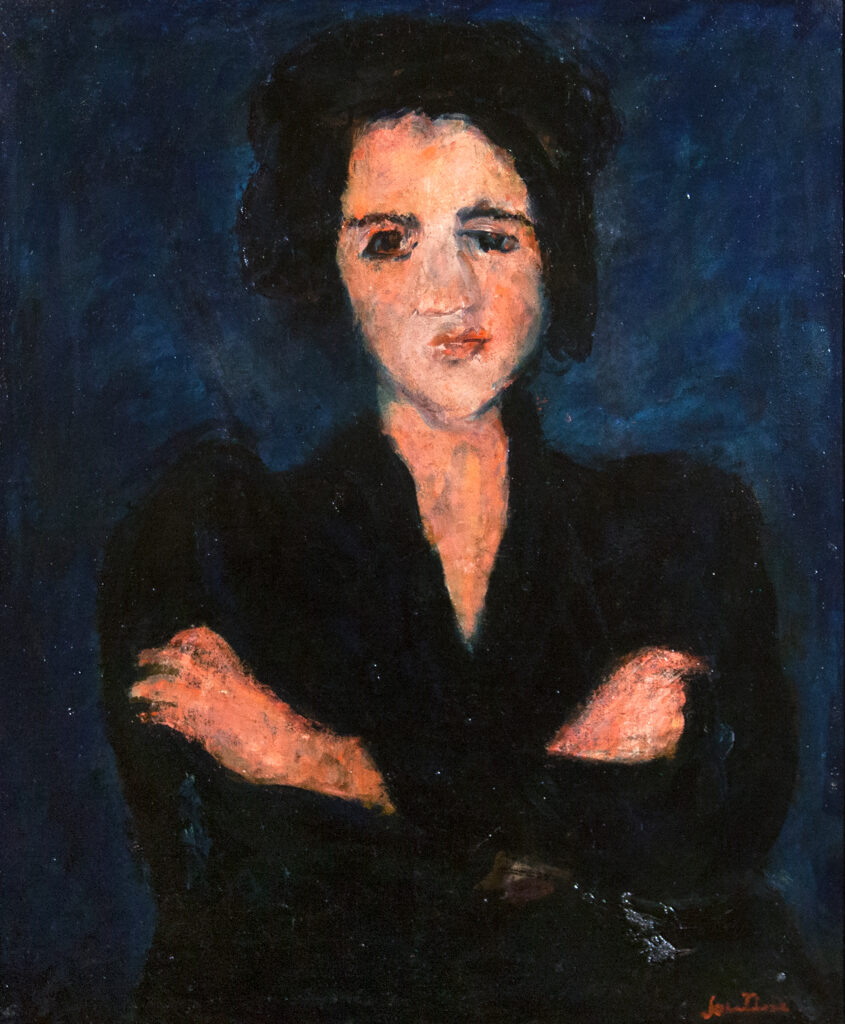
In the decade running up to the uprising, and during it, the Belgazprombank collection rose to considerable prominence beyond the borders of the country. Within Belarus itself, one of the collection’s most prominent works—Chaim Soutine’s 1928 painting Eva—became one of a number of symbols of popular dissent from the government’s actions. This painting dates from the high point of Soutine’s career in the 1920s, when he completed a remarkable series of portraits of hotel workers. The portrait dates from this period where Soutine was focusing on the precarious working-classes employed in catering[10].
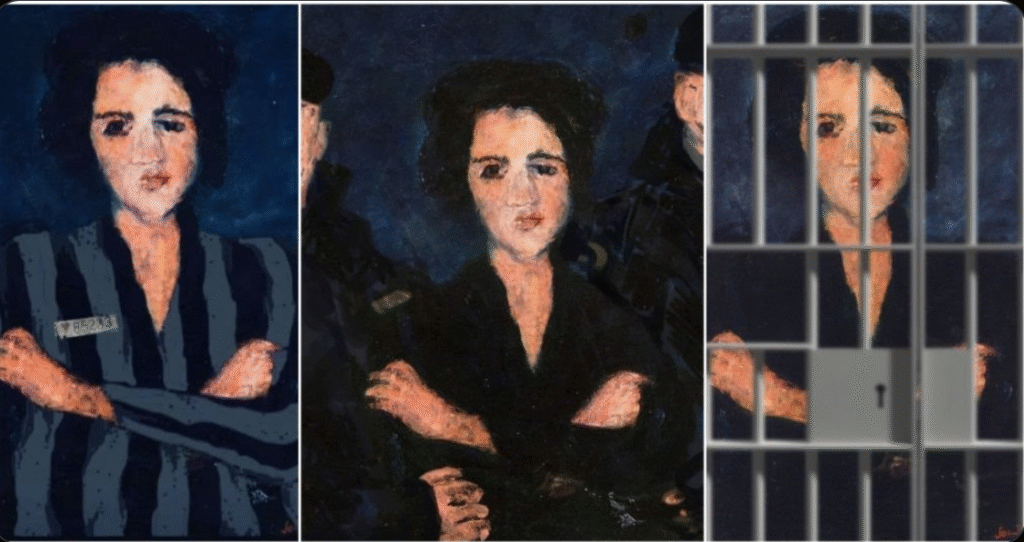
From the vantage point of the social media age, the composition of this work made it perfect for today’s generation of photoshoppers and gif makers. As a result, the work acquired a politically charged connotation in 2020, developing from the ingenuity of the people who have engaged with it. This use of clever visuals and straightforward humour was one of the defining characteristics of those involved in the Belarusian protest movement.
Eva popped up everywhere—on bags, t-shirts and as ever-shifting memes and graphics on social media. Her arms crossed, hugging herself defensively, the look from Eva’s smudged face is enigmatic; vulnerability, strength, pity, fatigue, alertness, defiance and contempt can be read into her expression. These jarring counterpoints of emotion mapped fairly closely onto the mood of many risking their liberty in pursuit of political change in Belarus at that moment.
The announcement of the election results in early August 2020 left the country astonished and angry at the fraud. The official result showed Lukashenka as having achieved just over 81% of the vote, compared to 10% for nearest challenger Tikhanouskaya, with Babarika disqualified. The most significant protests, from 9–15 August, were met with unprecedented levels of violent police response. Thousands were arrested after regular police and OMON riot police attacked unarmed demonstrators with batons, rubber bullets, and tear gas. Those arrested were subsequently savagely beaten in regime jails, with Minsk’s Akrestin Street prison acquiring a particular notoriety.
On the 15th August, local culture figures who had passed through these beatings in Akrestin Street organised a spontaneous street exhibition outside the Palace of the Arts in Minsk, entitled The Art of the Regime. The performance artist Artem Pronin stripped down to his underwear to show the bruises received all over his body, whilst photographs were displayed of other victims, including those inflicted on Ales Pushkin, at the time Belarus’ best-known contemporary artist and provocateur. Symbolically taking place outside of one of the few exhibiting spaces in Belarus, The Art of the Regime, held in open space, distanced itself from official discourse and aligned itself with the people, demanding that the right to peaceful protest in public space be respected. The appearance of posters, placards and art work of all kinds from amateurs to professionals was an attempt to symbolically jam the ‘order’ and ‘cleanliness” of public space in the everyday of dictatorship, an explosion of self-expression in normally very tightly controlled public space.
New Realities: Contemporary Practices in the Belarusian Diaspora
There is not the space here to detail the ongoing courage and bravery of unarmed citizens in attempting to challenge the paranoid dictatorial apparatus of militarised police and all-pervasive secret service, still called the KGB in Belarus. This was a clash between a state organised around verticals of power and violence, against a horizontally organised citizens movement that had figureheads, but represented a spectrum of all political opinions and none, from class struggle anarchism to conservative democratic nationalism. The challenge of the uprising was not so much in this range of political opinion but in empowering and giving confidence at community and courtyard (dvory) level to citizens who had never had anything other than a performative bit-part in political discourse to that point.
For every action, a reaction; eleven months after the uprising, Lukashenka led a concerted action to destroy the civil society that had nearly destroyed him. Mustering all the organs of control of the regime––the MVD (Ministry of the Interior), KGB (Committee for State Security), OMON, GUBOPIK (Anti-Corruption and Organised Crime Directorate), and Spetznaz (Militarised special forces). By the ‘Black Day of Civil Society’, July 14 2021, some 857 civil initiatives had been liquidated by the state or had closed voluntarily.[11] Amongst those lost were the OK16 exhibiting space and the Goethe Institute, one of the few remaining sources of foreign funding for artists.
This had the effect of denying space to artists in their efforts to play a part in the country’s transformation, as a countrywide purge not seen since 1937 took full effect. By the beginning of 2021, with many figures having received jail sentences or having left for exile in neighbouring countries[12], the contours of Belarusian visual culture shifted again, with a version of a Belarusian polyphony performed by many different artists, and new art organisations established, in exile.
One of the first manifestations of what was to become an art world in exile came with the large groups show ‘Every Day. Art. Solidarity. Resistance’ organised at the Mystetskyi Arsenal in Kyiv from March to May 2021. Curated by a mixed group of six artists and curators, this was perhaps the most comprehensive exhibition of Belarusian contemporary art for over a decade, since the ‘Opening the Door: Belarusian Art Today’ in Vilnius in 2010.[13] In the catalogue texts contributors spoke directly of the ways in which contemporary art was mutating under revolutionary processes:
The resistance movement began spontaneously and remains decentralised. It is arranged like a net, like water, like the endless process of embroidery…A new social sculpture is emerging that is self-forming and removes the hierarchy between professional art and grassroots creativity, where a street statement can become more pointed and accurate than an artistic project…By moving, mourning, organising, exhausting, refusing, celebrating together, we simultaneously rehearse and exercise the future.[14]
Visualising and scoping the nature and consequences of the mesh of revolutionary activity in Belarus since 2020 was one of the key themes animating the work on display. The process was described by the artist-researcher Olia Sosnovskaya as ‘Future Perfect Continuous’—-an action that began in the past, takes place in the present and will continue in the future. In many ways, this appropriation of a tense in English characterises the constellation of Belarusian practices in exile.
In the newer waves of Belarusian diaspora important new institutions have formed, or had their development accelerated exponentially by events. One of the cardinal resources is the research, exhibition and archive platform Kalektar, in existence since 2014–15 and a holding place for much of the information available in English in contemporary Belarusian art. Active in Belarus before the pandemic and uprising of 2020, Kalektar has focused its efforts since on facilitating and organising exhibitions around Poland and Germany, and in continuously developing a directory of historical and contemporary Belarusian artists. This colossal undertaking is already shaping a vital resource with a database that would normally be hosted by a national institution. It is one of the very few privately run archives in Europe focusing on a national art history and contemporary art practice—only the ZAUM archive in North Macedonia fulfils a similar function, albeit in different circumstances.[15]
Curator Olga Mzhelskaya, based in Warsaw since 2021, has collaborated actively with the Polish Museum of Modern Art and seeks to create opportunities for residency and exhibition for Belarusian artists, integrating them with Polish colleagues, as well as promoting the works of those in exile through her platform ‘Little Hedonist’[16] on Instagram. This account does much to give a flavour of the ever shifting networks of Belarusian artists in exile and the spaces that they gather in: Gray Mandorla, the shared studio of artists Sergey Shabohin and Alexei Lunev, and the physical headquarters of Kalektar in Poznan; the fascinating Mochnarte foundation in a village in Podlaskie, north-east Poland, very close to the Belarusian border, which has hosted artists such as the interdisciplinary performance artist Nadya Sayapina and, most recently, the group Bergamot (Volha Maslouskaya and Raman Tratsiuk), who have been collaborating together since 1998.[17] Mochnarte, founded by the philanthropist and art collector Walenty Sielwiesiuk, is also rapidly establishing one of the few collections of contemporary Belarusian art in private hands, perhaps a parallel organisation to the long established Jaan Manitski collection of contemporary Estonian art at Viinistu on the Baltic Sea[18].
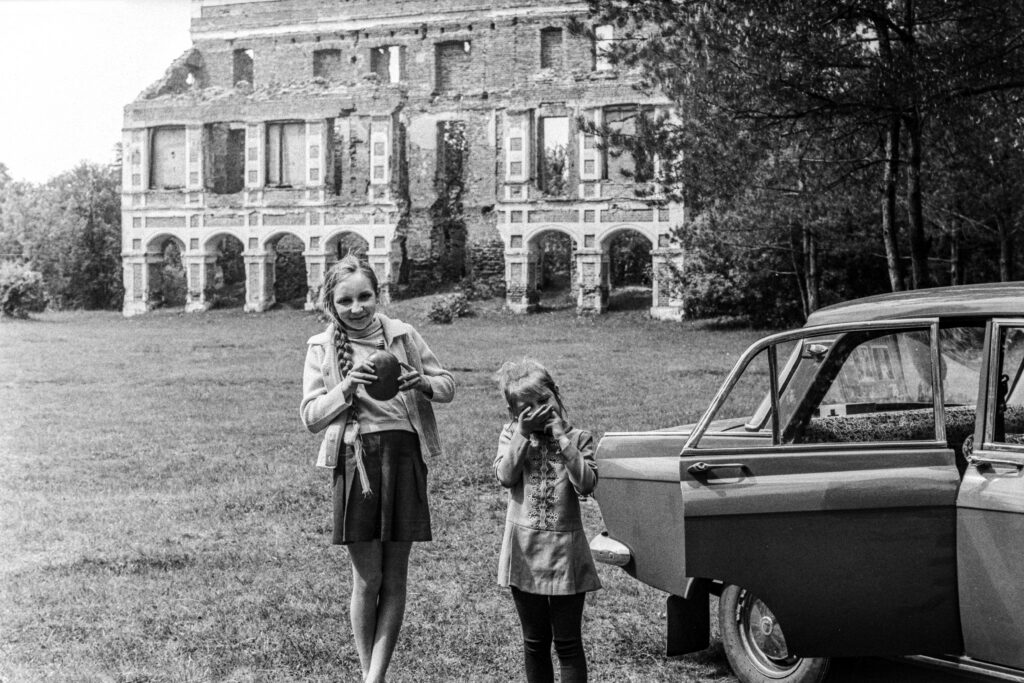
Perhaps one of the most affecting projects in the constellation of Belarusians working abroad is the VEHA archive,[19] established by the artist Lesha Pcholka[20] in 2021. Pcholka, together with artist Uladzimir Hramovich,[21] has been focusing of late on a series of photographic images entitled Ruins of Belarus, begun in late 2023, which are either gathered from official sources in Belarus or simply bought as old postcards from ebay; memories that lost their context and change hands for a few euros. This project is gradually amassing an astonishing collage of personal memories from the past century and more, focusing on religious buildings, ruins, family memories from Soviet times. The power of this project is that it seeks to bypass totalising historical narratives and instead offers a patient, durational re-building of a country through its people and individual narratives.
Conclusion
It is fundamentally important to abandon the paternalistic and consumerist approach to cultural processes. We should not talk about creating ‘new ministries’, but about creating new rules of existence—an environment conducive to the self-organization of creative communities. Not a vertical of authoritarian subordination, but a horizontal network of project structures and creative alliances.[22]
The vision of the Belarusian Council for Culture––a not-for-profit organisation established in Estonia in October 2020––for a future Belarusian culture based on new rules of engagement and based on self-organization and mutual aid, is a vision that would attract artists and managers alike, globally.[23] As I have shown in this essay, what is far from clear is how this noble vision might be achieved and what sort of future Belarusian society might host a re-imagined set of cultural audiences, conventions, debates and production. It goes without saying that the Lukashenka regime, little interested in culture and certainly nothing beyond clichéd visions of visual art as decoration or propaganda illustration, would be much more intent on suppressing any such future manifestation of culture than in supporting it.
The vision outlined above pre-supposes a seismic future political change in Belarus, which is not in the gift of artists or cultural workers to effect. For those remaining within the country, forced into displays of public conformity with the regime, or silence, whilst making work for small private circles or for themselves, the vision may seem more often than not simply to be fantasy, or idle chatter by those no longer subject to the daily rigours of life in a dictatorship. That daily task can be thought of as blameless acts of solidarity and kindness to fellows, to winning back time to make something genuinely creative and critical, even if it can never be shown in Belarus, or only shown abroad, anonymously, and with great difficulty. Late Soviet-era strategies of holding informal shows in domestic spaces, or making interventions in nature, to thinking critically individually or with trusted friends, making work in the privacy of a studio ‘for the drawer’, are reportedly still quite common, although, for obvious reasons, unknown to all but a very few. Mikhail Gulin, now based in Poland, observes that: “In Belarus itself, the big question is how soon ‘gray zones’ will appear in which it will be possible to exist more or less calmly. ‘Gray zones’ I call spaces where the state allows some initiatives to exist. This has already happened in recent history: permitted civil initiatives, entire permitted city blocks imitating ‘normal’ life for visiting foreigners or the local liberal public.”[24]
There is now a deep fissure in mutual understanding between those artists who remain subject to these working conditions in Belarus, and the scattered diaspora abroad—in Vilnius, Warsaw, Poznan, Berlin, Tblisi, Kyiv and many other European cities. Travel to and from Belarus is now much more difficult, and for creatives in exile returning would expose the traveller to unacceptable levels of risk, if return could be contemplated at all. For most in the diaspora, commonalities are sought in formal and informal art spaces in these cities, or online, through privately organised resources for Belarusian art. In learning unfamiliar rituals of mundane daily tasks, housing, how to support an art practice from a very precarious position, how to frame the narratives of Belarusian art production, those artists who have left have taken their place in a wider European precariat, using strategies of biography, activism, humour and artist-research on subjects from cartography to labour history. The consequences of this work, both for diasporic communities, and those increasingly remote figures still in Belarus, are only at the beginning of their unfolding, united by the involvement of many in the events of 2020-21, the processing of these life-altering processes, and a strong desire by a large majority to return back to a very different country, where at least some of their unrealised dreams for a better future could be realised.
Perhaps it is best to leave a conclusion to the philosopher, writer and activist Tania Archimovich, whose words increasingly have relevance beyond the immediate specificities of Belarusian art, and its role in creating space to resist.
…the challenge that will always remain relevant is resistance to our own fatigue…it is what is expected from us––both locally and globally––we are expected to put up with what we have and start to function in the conditions someone created for us. And this submission should not be permitted.[25]
Bibliography
Arcimovich, Tania, ‘From Isolation to Publicity? Exhibitions New Art of Belarus (Warsaw, 2000) and Opening the Door? Belarusian Art Today (Lithuania, 2010)’ in Zhgirovskaya, O, Shparaga, O and Vashkevich, R, editors. Zero Radius : Art Zeroes Ontology, Minsk, 2013
Borisionok, Alexei, ‘Production Drama : Labour and Laziness of Artists in Belarus’, Hjarnström, Belarus / Sverige, 2018
Borisionok, Alexei, ‘Queer Temporalities and Protest Infrastructures in Belarus, 2020–22: A Brief Museum Guide’, e-flux, 17th May 2022
Borisionok, Alexei, Dureika, Andrei, Naprushkina, Marina, Shabohin, Sergei, Stebur, Antonina & Tyminko, Maxim, Every Day. Art. Solidarity. Resistance. Mystetski Arsenal, Kyiv, March-May 2021
Hansbury, Paul, Belarus in Crisis: From Domestic Unrest to the Ukraine War, London, 2021
Ioffe, Grigory, ‘Understanding Belarus : Belarusian Identity’, Europe-Asia Studies, Vol. 55, no. 8, December 2003
Kopenika, Olga, ‘No Time for Art? Strategies of Negation in Belarusian Art during the Anti-Government Uprising’, Field, 2022
Korosteleva, Elena & Petrova, Irina, ‘Community Resilience in Belarus and the EU Response’, Journal of Common Market Studies, 2021, 1-13
Levchuk, Margarita (2023), Blood on the Grass, film. Accessible here: https://www.youtube.com/watch?v=EcYX14-mM38&t=2880s
Pcholka, Lesia, Descent into the Marsh, Belarus / Hong Kong, 2024
Belarusian Council of Culture, ‘More than Culture: Manifesto of the New Belarusian Culture’, published 29th December 2024. https://byculture.org/en/more-than-culture/
Zhurauliova, Tatsiana, ‘The Non-Identity Problem in Contemporary Belarusian Art’, in Mardilovich, Galina and Taroutina, Maria, editors, New Narratives of Russian and East European Art Between Traditions and Revolutions, Routledge, 2020
A very accessible history of the story behind Belarus’ two flags can be found in Margarita Levchuk’s short film, Blood on the Grass (2023), accessible at: https://www.youtube.com/watch?v=EcYX14-mM38&t=2880s ↑
Valentin Volkov’s 1955 socialist realist painting, Minsk, 3 July 1944 gives a visual flavour of how the current Belarusian regime likes to see liberation day, according to their perspective, See https://archives.gov.by/en/news/1008289 ↑
Written answers to interview questions from to the author, 19 March 2025. ↑
Interview with Uladzimir Hramovich, 13th March 2025. ↑
Interview with Mikhail Gulin, 25th March 2025 ↑
Interview with anonymous contributor, 12th March 2025 ↑
Aleksei Borisionok, “Labour and Laziness of Artist in Belarus”, Status Platform, July 2020. Accessible at: https://statusproject.net/production-drama-labor-and-laziness-of-artist-in-belarus/. Last visited 24 March 2025. ↑
Belgazprombank is one of the largest independently owned banks in Belarus. The majority shareholders are the Russian energy giant, Gazprom. Under the chairmanship of Viktor Babariko, who relinquished his position on May 12th 2020, to stand as a presidential candidate against Lukashenko, the bank invested significant sums in building up a very impressive corporate art collection, and sought to fill gaps in national collections by using it’s financial power to buy significant works made by Belarusian artists abroad––everything from sixteenth century rare maps and prints, to paintings and sculptures made in Paris between the wars. Babariko was also known as a patron of the arts, with Belgazprombank establishing and financing the OK16 cultural centre in a former Minsk toll-making factory. Babariko also helped finance the annual Autumn Salon for emerging Belarusian artists, but this patronage also attracted some criticism. Olga Kopenkina observed that: “The ‘winning’ artists [of the Autumn Salon], however, remain impoverished because the art market in Belarus is rudimentary and undercapitalised, and there is no comprehensive system of compensation for the artists who participate in the exhibitions.” ↑
See https://chrysalismag.org/home and on https://instagram.com/chrysalismagazine ↑
Belgazprombank acquired the painting from an auction at Sotherby’s in New York in May, 2013, for a sum of $1.8 million, three times the estimated price. The work, which had been in the United States since 1952, became a cornerstone of Belgazprom’s developing collection and briefly appeared at the arts centre named after Soutine, founded in 2008 in his old home town. It’s one of the most valuable artworks located in the country at present. ↑
This was one of the topics covered in an infamous lengthy interview between Lukashenka and BBC’s Moscow correspondent Steve Rosenberg, on 21 November 2021, and accessible at: https://www.youtube.com/watch?v=ArWeoIK3Idc ↑
Amongst those exiled were presidential challenger Sviatlana Tikhanouskaya, who was forced into exile under duress in August 2020. On August 11 2020 she made a statement on television, clearly distressed, calling for citizens to respect the election results and not to confront police or take to the streets. She moved to Lithuania after a threat was allegedly made against her children, and imprisoned husband Siarhei, by the KGB. Subsequent to the election Victor Babarika was jailed for 14 years, in May 2021; Maria Kalesnikava, a close associate of Babarika’s and candidate alongside Tikanouskaya, was jailed for 11 years in September 2021. ↑
For more information on this exhibition see https://cac.lt/en/exhibition/opening-the-door-belarusian-art-today/ ↑
Curatorial Text in Every Day. Art. Solidarity. Resistance. Kyiv, 2021. 5-8. Catalogue available online at: https://kalektar.org/in/names/vSLhc8xrnVjGfP1j95Xx ↑
See https://kalektar.org/i/p/history for a detailed timeline of Kalektar’s history. The directory of Belarusian artists, movements and institutions can be found at https://kalektar.org/in/names/. I have written elsewhere about ZAUM archive in “Letter from Skopje”, Art Monthly no. 480, October 2024.
ZAUM, founded in 2016/17, is conceived of as part archive, part infrastructure, part art work, and was initiated and still run by the artists Denis Saraginovski and Slobodanka Stevcheska. It can be visited at: https://arhiva.zaum.mk/ ↑
More information on the Mochnarte Foundation, its gallery and residency programme, can be found here: https://mochnarte.org/ ↑
For more details on the Jaan Manitski collection, established in 2002, see: https://www.erm.ee/en/content/jaan-manitski%E2%80%99s-private-art-collection ↑
VEHA archive can be accessed at: https://veha-archive.org/ ↑
Lesha’s personal website can be found at https://a-lesia.com/ and on Instagram: https://instagram.com/lestvoidom ↑
Uladzimir’s work can be seen at https://hramovich.com and on Instagram: https://instagram.com/uladzimir__hramovich ↑
“More than Culture : Manifesto of the New Belarusian Culture”, Belarusian Council for Culture, published 29.12.24. https://byculture.org/en/more-than-culture/ Last accessed 22nd March 2025. ↑
The Belarusian Council for Culture (BCC) has been a non-profit charitable organization registered in the EU (Estonia) since October 2020 under the name MTÜ Valgevene Kultuuri Assotsiatsioon. In May 2023, it was granted human rights organization status. ↑
Interview with Mikhail Gulin, 24th March 2025. ↑
Tania Archimovich in a roundtable discussion on the theme “Intellectual Resistance : New strategies- a roundtable discussion on Belarus and Ukraine”, first published in Partizan no. 29, 2015, re-published in Eurozine, 12th January 2016, 8 ↑